Because a lot of usage problems, malfunction problems, selection problems all stem from one premise:
Whether you really understand how it works.
Let's start today with the most typical hydraulic attachment - the hydraulic breaker.
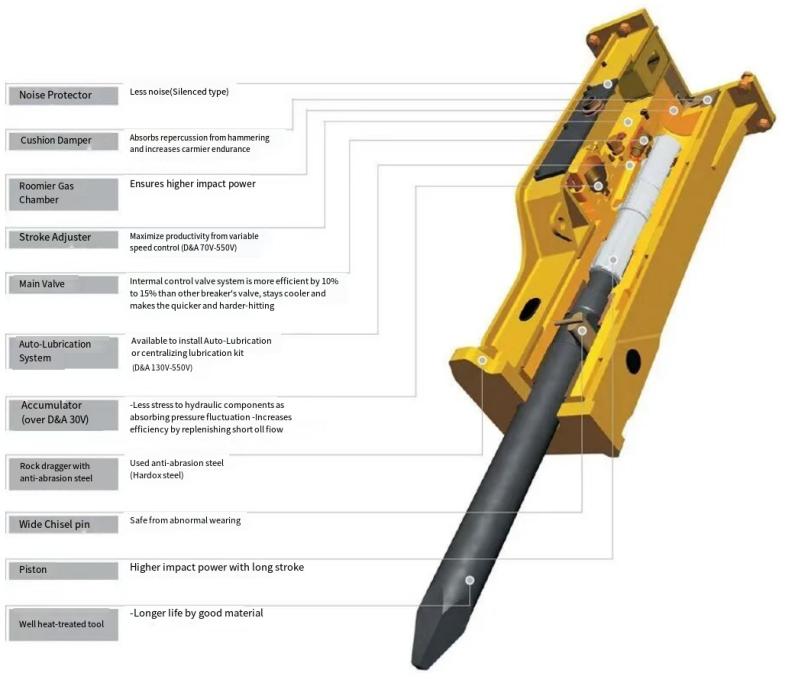
01 The breaker is not essentially a "vibrator" but a "shock"
Many people are accustomed to saying "smash the stone".
But the way a breaker works is not a continuous vibration, but a high-frequency single impact.
Its core action can be broken down into four stages:
1) Hydraulic oil enters to push the piston
2) The piston moves up to compress the energy storage system
3) The piston drops rapidly after reversing
4) The piston strikes the drill rod to produce shock waves
It's not the pressure but the impact energy at that moment that really breaks the rock.
02 Where does the energy come from?
Many people would simply think of it as:
"The excavator provides pressure, so the breaker works."
In fact, a more accurate statement would be:
The excavator provides hydraulic energy, and the breaker converts the hydraulic energy into kinetic energy.
The flow and pressure of the hydraulic oil determine the speed and impact strength of the piston.
But the impact effect doesn't depend solely on the pressure.
It also involves:
·Piston mass
·Stroke length
·Impact frequency
·Energy conversion efficiency
That's why breakers of different brands and structures perform so differently on the same host.
03 Why is there nitrogen?
Most traditional breakers use nitrogen energy storage structures.
The role of nitrogen is:
It is compressed and stored as the piston moves up, and releases energy as it moves down to assist in acceleration.
Simply put:
Nitrogen is like a "spring".
It can:
·Improve impact efficiency
·Stabilize operating frequency
·Reduce fluctuations in the hydraulic system
But note:
Not all breakers rely on nitrogen.
The fully hydraulic structure design, which is common in European and American markets, completes the energy cycle through hydraulic control and no longer relies on gas energy storage.
There are also domestic companies that have developed fully hydraulic breakers and have received good market feedback.
The structures are different, and so are the maintenance methods.
04 Relationship between Frequency and impact Force
Many users are concerned about:
Is a higher frequency always better?
The answer is not absolute.
Breaking efficiency depends on:
Impact energy × number of effective impacts.
High frequency works for softer materials, high single energy works for harder rocks.
If the energy is insufficient in a single shot, no matter how high the frequency is, it will only be an "empty strike".
In turn, excessive single energy can result in energy waste on soft materials.
Therefore, the selection should not be based solely on "beating fast", but also on the material properties.
05 Why does "empty strike" occur?
Understanding the principle of impact can explain a common problem:
An empty run is not "no oil".
Empty runs typically occur at:
When the drill rod is not in close contact with the material.
When the drill rod does not form a reaction force, the shock wave cannot be transmitted to the target object, and the energy bounces back to the body.
A long period of empty driving can result in:
·Internal structural impact damage
·Excessive wear of the seal
·Abnormal energy storage system
This is why the operating specifications stress that the impact must be initiated only after the material is pressed down.
06 Why is mainframe matching important?
A breaker doesn't work just by installing it.
It needs to match with the host:
·Flow range
·Working pressure
·Return oil unobstructed
·Pipeline cleanliness
Too little flow → Weak strike;
Too much flow → too fast temperature rise;
Abnormal pressure → Damaged seal.
Many faults are not problems with the attachment itself, but rather matching issues.
07 Understand the meaning of the principle
When you understand how the breaker converts hydraulic energy into impact energy, many phenomena are no longer mysterious:
·Why does the temperature rise
·Why do the rods wear out
·Why seals have different lifespans
·Why is there such a big difference in efficiency across different operating conditions
Technical problems often stem from principles.
ZhongSheng Machinery (ZHSTECH) manufactures robust excavator attachments, providing high-performance Hydraulic Breakers, Rippers, and Pulverizers for demanding demolition and construction work.With a commitment to quality and innovation, ZHSTECH ensures reliable performance and long-lasting durability for every attachment.