ZhongSheng Machinery (ZHSHTECH) manufactures robust excavator attachments, providing high-performance Hydraulic Breakers, Rippers, and Pulverizers for demanding demolition and construction work.
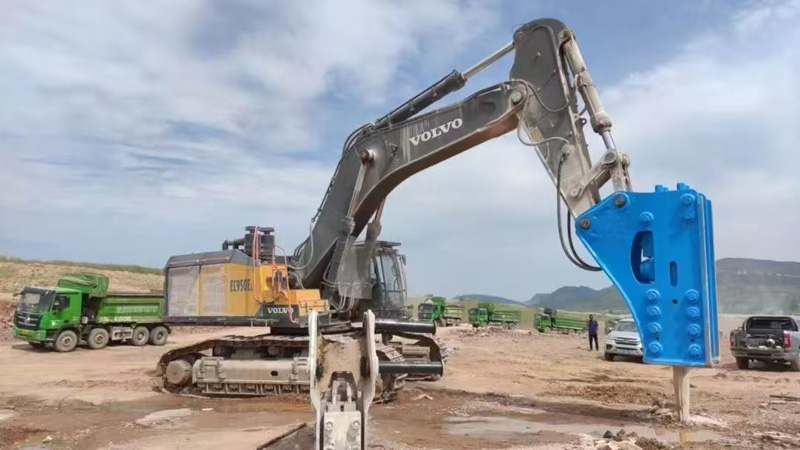
I. Working Principle
Hydraulic breaker (also known as breaker hammer, rock breaker) is a core attachment of excavators, applied in mining, building demolition and other working conditions. It achieves crushing based on the synergistic effect of hydraulic pressure and nitrogen gas, and its working cycle is divided into four stages:
1.Return Stroke Acceleration: High-pressure oil enters the rear chamber of the piston, pushing the piston upward and compressing the nitrogen chamber;
2.Return Stroke Braking: After the piston reaches the position, the directional valve switches to cut off the high-pressure oil circuit;
3.Power Stroke Acceleration: The expansion force of nitrogen gas and hydraulic oil act together to push the piston downward at high speed;
4.Impact Process: The piston impacts the drill rod with huge kinetic energy to complete the crushing.
II. Core Structure and Composition
The hydraulic breaker is composed of three core components, each with clear functions: The upper cylinder block (nitrogen chamber) is responsible for storing low-pressure nitrogen gas and plays an energy storage role; The middle cylinder block (oil cylinder) contains key components such as piston, accumulator and directional valve, which is the core of power transmission; The lower cylinder block (front body) is used to install drill rod, inner and outer bushings and other components directly involved in crushing. Among them, the accumulator can buffer impact and vibration, achieving the effect of protecting equipment and extending service life; The drill rod, as a striking component directly in contact with materials, needs to be replaced regularly to ensure crushing efficiency; The directional valve controls the flow direction of hydraulic oil to realize the reciprocating movement of the piston, which is a key control component for cyclic work.
III. Selection and Matching Guide
Core Principles of Selection
In terms of weight matching, the weight of the hydraulic breaker should be controlled at 10%-15% of the excavator's tonnage to avoid mismatching problems such as "a small horse pulling a large cart" or "a large horse pulling a small cart". The hydraulic system matching needs to meet three requirements: In terms of flow rate, the flow rate of the hydraulic breaker should be 60%-80% of the total flow rate of the excavator's standby valve; In terms of pressure, the maximum discharge pressure of the excavator should be 30-40bar higher than the working pressure of the hydraulic breaker; The nitrogen pressure must be filled in strict accordance with the manufacturer's regulations; too high or too low pressure will directly affect the impact force. The selection of structure type should be combined with the use environment: The side-mounted hydraulic breaker has a simple structure, convenient maintenance and low cost, suitable for scenarios with low noise requirements such as mines; The top-mounted hydraulic breaker has strong impact force and high energy transmission efficiency, more suitable for large-scale excavators; The box-type silent hydraulic breaker has low noise and good vibration reduction effect, which is an ideal choice for urban construction.
IV. Correct Operation and Maintenance
(1) Pre-operation Inspection
Five key inspections must be completed before use: First, confirm that there are no loose bolts and no oil leakage at pipelines and joints; Second, check the cleanliness and oil level of hydraulic oil to ensure that the oil is free of impurities and sufficient; Third, check the wear of inner and outer bushes, requiring that the unilateral gap between the drill rod and the outer bush does not exceed 5mm; Fourth, check the pressure regularly, the nitrogen chamber should be checked every two weeks, and the accumulator should be checked every month; Fifth, replace the filter element according to the cycle, and the crushing pipeline filter element needs to be replaced every 100 hours.
(2) Lubrication and Maintenance Specifications
Lubrication and maintenance must follow clear standards: Grease should be added after 2 hours of continuous work, 15-20 times each time, and it must be injected when the drill rod is pressed in to avoid grease entering the impact chamber and causing pollution; The replacement cycle of hydraulic oil is 600-1000 hours, 68# hydraulic oil is recommended in summer, and 46# hydraulic oil is recommended in winter; The oil seal replacement must strictly follow the cycle requirements, limited to 3 months or 500 hours of work, whichever comes first.
(3) Operation Taboos
Five taboos must be strictly avoided during operation: The drill rod must be kept perpendicular to the crushing surface, and horizontal striking and large-angle oblique striking are strictly prohibited; The drill rod should be pressed tightly against the crushing surface, and the operation should be stopped immediately after the material is crushed to prevent empty striking from damaging the equipment; The continuous striking time on the same impact surface shall not exceed 1 minute, and the impact point shall be replaced in time; Operation in water (except for the drill rod) or muddy environment is strictly prohibited; It is forbidden to use the hydraulic breaker to sweep and dig materials or push heavy objects, so as to avoid faults caused by exceeding the designed use of the equipment.
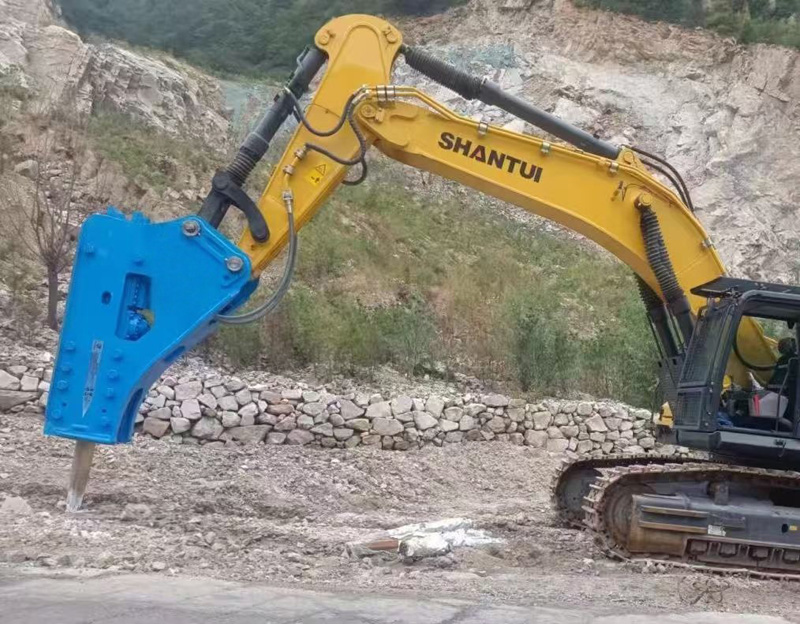
V. Common Faults and Handling
Common causes of weak impact include insufficient nitrogen pressure, insufficient hydraulic oil pressure, worn drill rod and dirty hydraulic oil. During handling, it is necessary to check the nitrogen pressure, static oil pressure and working oil level one by one, replace worn parts and replace or filter the hydraulic oil in time; Oil leakage faults are mostly caused by worn sealing rings, loose oil pipe joints or damaged piston seals. It is necessary to replace the corresponding sealing rings according to the oil leakage position and fasten the oil pipe joints at the same time; Failure to strike may be caused by stuck directional valve, closed stop valve, insufficient hydraulic oil or the nitrogen chamber being filled with hydraulic oil. It is necessary to check the status of the directional valve and stop valve, supplement hydraulic oil and clean the nitrogen chamber; Unstable striking frequency is usually caused by too little hydraulic oil, damaged relief valve or slight scratches on the piston and control valve. The handling method is to supplement hydraulic oil, check the working condition of the relief valve and replace damaged parts.
VI. Long-term Storage Requirements
Before long-term storage, the equipment must be fully maintained, damaged parts repaired and thoroughly cleaned to ensure the good technical condition of the equipment, and it should not be stored together with corrosive items. Four operations must be completed during storage: Install plugs at the pipeline interfaces to prevent impurities from entering; Completely release the nitrogen gas in the nitrogen chamber; Remove the drill rod and store it separately; Aim a round bar at the impact end face of the piston and tap to retract the piston to the rear position. The storage location should be a dry indoor area. If it has to be placed outdoors, a flat ground covered with wooden boards should be selected, and the storage should be covered with a cloth to prevent rain. When arranging the equipment, it is necessary to ensure that the entry and exit of any machine are not affected by other machines, so as to facilitate subsequent access.